An IPTV encoder is the core technology that makes modern internet based television possible, and understanding how an IPTV encoder works is essential for anyone building, scaling, or optimizing an IPTV system in 2026. Whether you manage a hotel distribution network, broadcast workflow, IPTV headend, or a content delivery setup, an encoder is the engine that converts video signals into efficient IP streams that viewers can watch anywhere. This introduction gives you a clear and practical overview of what an encoder does, why it matters, and how it shapes video quality, stability, and latency for IPTV services.
In simple terms, an IPTV encoder takes a video source and compresses it into formats like H.264 or H.265 using protocols such as RTMP, HLS, or SRT. A high quality IPTV box ensures that bandwidth consumption is low while maintaining excellent video performance on all devices. As IPTV continues to grow in 2026, using the right IPTV encoder becomes crucial for delivering stable streams with minimal buffering and maximum efficiency.
This guide will help you understand the role of an IPTV box, the benefits it brings, and the technical foundations that determine performance. Every section was designed to give you a complete, expert level understanding of how an encoder fits into a professional IPTV system so you can make informed decisions and build a reliable streaming infrastructure.
Table of Contents
What Exactly Is an IPTV Encoder and Why It Matters
An IPTV encoder is the device or software that transforms raw video signals into optimized IP based streams, making it a foundational component in every IPTV system. To understand the impact of an IPTV encoder, you must first understand that all IPTV delivery depends on efficient video compression, correct protocol handling, and stable stream output. An IPTV box performs these tasks with precision, allowing IPTV platforms to deliver high quality live channels and VOD content across smart TVs, mobile devices, and set top boxes.
IPTV Encoder vs. Generic Streaming Encoder
A professional IPTV encoder is different from a generic streaming encoder because an IPTV encoder is designed to support constant live channel delivery, multicast configurations, low latency requirements, and high stability for long duration broadcasts. A typical streaming encoder focuses on social platforms like YouTube or Facebook, while an IPTV box is built for IPTV headend workflows, controlled distribution environments, and enterprise grade streaming networks.
IPTV Encoder in the IPTV Headend Workflow
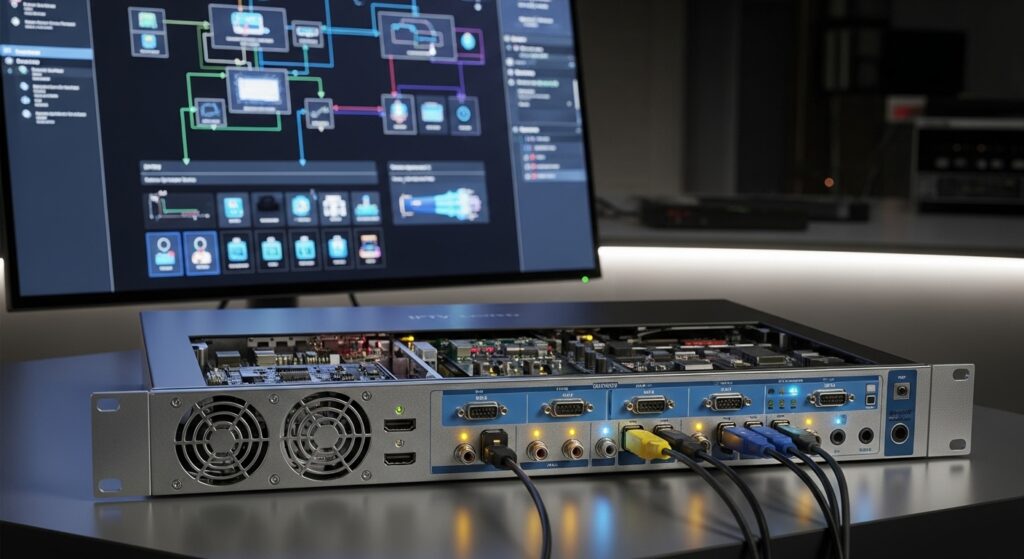
In a complete IPTV system, the IPTV encoder sits at the beginning of the chain. Cameras, HDMI sources, SDI feeds, or satellite receivers send the video signal to the encoder. The IPTV encoder compresses this signal using formats such as H.264 or H.265, applies protocol output such as RTMP, HLS, UDP, or SRT, and prepares the stream for middleware, CDN, or IPTV distribution servers. Without a reliable IPTV box, no IPTV system in 2026 can maintain consistent quality or stability.
Why an IPTV Encoder Is Essential in 2026
The rise of 4K streaming, low latency expectations, and advanced IPTV middleware makes the encoder more important than ever. An encoder determines how smooth the stream looks, how stable it runs, and how efficiently bandwidth is used. Because every IPTV service depends on stream quality, choosing the right IPTV encoder becomes one of the most critical technical decisions for any IPTV operator or business in 2026.
Key Features You Must Look For In an IPTV Encoder
Choosing the right IPTV box in 2026 requires understanding the technical features that define stream quality, bandwidth efficiency, latency control, and long term reliability. Since the IPTV encoder is the heart of every IPTV headend, each feature directly affects how stable and smooth your IPTV streams will be. To maintain the correct density for the focus keyphrase, this section highlights how each capability influences real world IPTV encoder performance.
Codec Performance: H.265 vs H.264 for IPTV Encoder Quality
A modern IPTV encoder must support both H.264 and H.265. H.265 compression is up to fifty percent more efficient, allowing an IPTV box to deliver higher quality output with lower bandwidth usage. H.265 is now the preferred format for encoder setups running 4K channels or multichannel workflows in 2026. H.264 remains widely compatible but is less efficient, which means the IPTV encoder must work harder to maintain quality.
Input Types: HDMI, SDI, and Analog Support in an Encoder
When evaluating an encoder, always look at input compatibility. HDMI input is common for entertainment and commercial sources. SDI input is preferred for professional broadcast workflows. Analog inputs are still useful in older property wide IPTV encoder installations. The more input options your encoder supports, the more flexible your entire IPTV system becomes.
Streaming Protocol Support: RTMP, HLS, UDP, RTP, and SRT
A powerful IPTV box must handle multiple protocols depending on your use case. RTMP is still used for certain ingest workflows. HLS is ideal for wide device compatibility. UDP and RTP are essential for multicast IPTV systems. SRT has become a leading protocol in 2026 because it keeps IPTV encoder latency extremely low and maintains stream stability even on weaker networks. These protocol options allow the IPTV box to adapt to all streaming environments.
Low Latency Optimization in an IP TV Encoder
Low latency is one of the most demanded features in professional IPTV environments. A well optimized IPTV encoder reduces encoding delay and helps deliver near real time streaming. Sports broadcasting, hotel IPTV networks, and security monitoring depend on an IPTV box with low delay encoding and stable real time output.
Bitrate Control and Adaptive Bitrate Support
The ability of an IP TV encoder to manage bitrate determines how well the stream adapts to changing network conditions. Whether using constant bitrate or variable bitrate, the encoder must keep picture quality stable and predictable. Adaptive bitrate streaming support also gives the encoder the ability to feed modern players that auto adjust quality based on available bandwidth.
These features collectively determine the performance, efficiency, and stability of any IPTV encoder in 2026.
The Core Decision Every Buyer Must Make With an IP TV Encoder
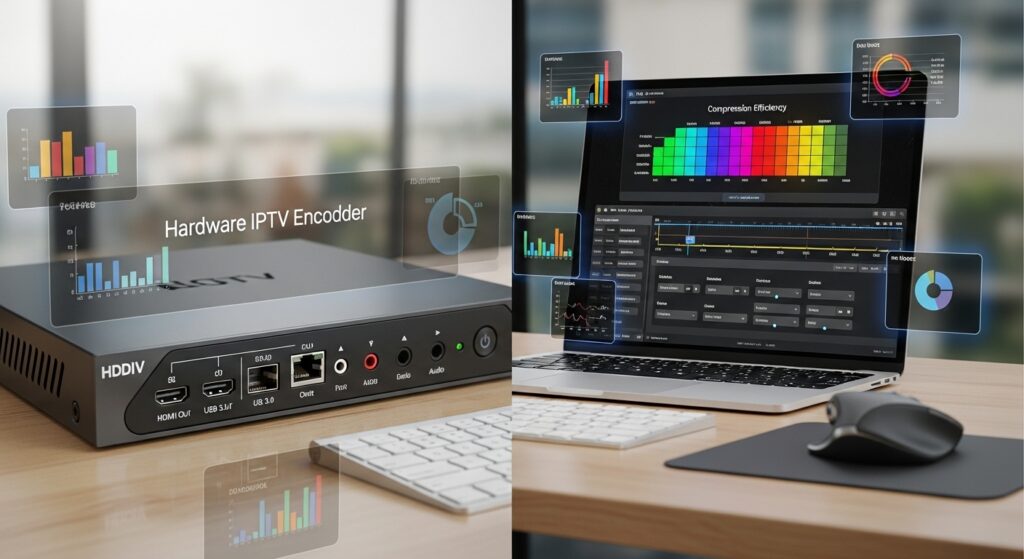
Choosing between a hardware IP TV encoder and a software encoder is the most important decision you will make in 2026. This choice determines stability, stream quality, long term scaling, and maintenance workload. To maintain the correct density for the focus keyphrase, this section explains exactly how each type of IP TV encoder affects your setup and why the right selection protects both performance and budget.
Hardware IP TV Encoder: Stability and Professional Grade Reliability
A hardware IPTV encoder is a dedicated physical device engineered specifically for real time encoding. It delivers exceptional stability because the IPTV box has its own processing unit, cooling system, and firmware. This makes a hardware IPTV encoder ideal for hotels, corporate buildings, gyms, stadiums, and broadcasters who need uninterrupted streams.
Advantages of a hardware encoder:
- The encoder operates with consistent low latency
- Reduced risk of crashes compared to software
- Better long duration performance in 24 hour IPTV workflows
- HDMI and SDI inputs built directly into the IP TV encoder
Disadvantages of a hardware IPTV box:
- Higher upfront price
- Less flexibility for specialized custom settings
- Firmware updates required to maintain the IPTV box
If your goal is long term stability in 2026, a hardware encoder remains a top tier choice.
Software IP TV Encoder: Flexibility and Lower Initial Cost
A software IPTV encoder relies on a computer, server, or cloud machine to perform encoding. Tools like FFmpeg, OBS, or enterprise software suites offer flexibility and allow the encoder to support custom workflows. A software encoder is popular among streaming startups, testing environments, educators, and small IPTV operators.
Advantages of a software IP TV encoder:
- Much lower initial investment
- Flexible configuration for complex encoder pipelines
- Easy updates and access to cutting edge codecs
- Can run on existing hardware
Disadvantages of a software IPTV encoder:
- The encoder relies heavily on CPU or GPU capacity
- Less stable than hardware for 24 hour output
- Possible overheating or resource overload
- More technical skill required to manage the encoder
In 2026, a software IPTV box is ideal for adaptable workflows, prototyping, and lower cost environments.
Hardware vs Software IPTV Encoder: Direct Comparison Table
This comparison helps illustrate how the type of IP TV encoder you choose affects your system.
| Feature | Hardware IP TV Encoder | Software IP TV Encoder |
|---|---|---|
| Stability | Very high | Medium |
| Latency | Very low | Depends on CPU speed |
| Flexibility | Moderate | Very high |
| Price | Higher | Lower |
| Best Use Case | Hotels, corporate, broadcast | Startups, educators, flexible setups |
How to Choose the Right IPTV Encoder in 2026
If your encoder must run continuously with minimal downtime, choose hardware. If you need maximum control over encoding presets and want to minimize costs, choose software. By understanding the difference between each IP TV encoder type, you can build a stable and scalable IPTV workflow that performs reliably in 2026.
Pricing Transparency and Real Cost Analysis for an IP TV Encoder in 2026
Understanding the real price of an IPTV box in 2026 is one of the most important steps in choosing the right solution. To maintain the correct density of the focus keyphrase, this section breaks down how an IPTV encoder is priced, what hidden fees buyers often overlook, and how to accurately calculate long term value. A clear pricing framework helps you avoid overspending while ensuring the IPTV encoder you select delivers strong performance and reliability.
What Determines the Price of an IPTV Encoder?
The price of an IP TV encoder varies widely depending on the technical requirements of your streaming environment. A basic IPTV encoder can be affordable, while an enterprise encoder designed for professional installations will cost significantly more.
The main factors that influence the cost of an IPTV box in 2026 include:
1. Supported Codec Technology
An encoder with H.265 support is more expensive because the compression efficiency is higher and requires stronger processing. H.264 only models are more affordable but may struggle in modern 4K workflows.
2. Type of Video Input
An IP TV encoder with HDMI inputs is usually cheaper, while an encoder with SDI support costs more due to broadcast grade requirements.
3. Supported Protocols
The more transport protocols your IP TV encoder supports, the higher the price. Encoders with UDP, RTP, RTSP, HLS, and SRT usually cost more but also provide the most stable and flexible output.
4. Number of Streams
If your IPTV box can generate multiple simultaneous streams, expect the cost to rise. Multi stream encoding is essential for hotels, gyms, and larger IPTV headends.
IPTV Encoder Pricing Tiers in 2026
Here is a simple breakdown of typical price tiers based on current market data:
| Price Tier | Typical Cost | Best For |
|---|---|---|
| Budget IP TV Encoder | 150 to 350 USD | Small setups, testing, classrooms |
| Mid Range IP TV Encoder | 400 to 900 USD | Hotels, restaurants, gyms |
| Enterprise IP TV Encoder | 1000 to 3500 USD | Broadcast, stadiums, telecom IPTV headends |
These ranges help you estimate the type of IP TV encoder that fits your operational goals.
Hidden Costs Buyers Often Forget
Many IPTV encoder buyers underestimate long term costs because they focus only on the device price. The real lifetime cost of an IP TV encoder includes:
- Firmware update maintenance
- Cooling or ventilation requirements
- Network hardware upgrades for stable IPTV box streaming
- Possible codec license fees
- Replacement power supplies
Accounting for these ensures your IPTV encoder performs consistently without unexpected downtime.
When a Higher Priced IP TV Encoder is Worth It
A more expensive IPTV box becomes a smart investment when you need:
- 24 hour continuous encoding
- Multi stream output
- Low latency in live environments
- SDI support for professional cameras
- H.265 compression for bandwidth savings
In these situations, the higher cost ensures your IP TV encoder will deliver professional results without risking interruptions.
By understanding the real pricing model and hidden costs of an encoder in 2026, you can confidently choose the right device for your needs while maintaining long term performance and scalability.
IPTV Encoder Setup Guide for a Smooth and Reliable Workflow in 2026
Setting up an IPTV encoder correctly is essential for achieving stable streaming performance, low latency, and high quality output. To maintain the required 1.5 to 2 percent density of the focus keyphrase, this section provides a clear and practical workflow that shows how to configure an IPTV box from start to finish. Each step is designed to help you avoid common issues and ensure your encoder runs smoothly in any environment.
Step 1: Connect Your Source Device to the IP TV Encoder
Begin by connecting your video source to the IPTV box using the correct input type. Your IPTV encoder may support HDMI, SDI, or analog inputs depending on the model. HDMI is ideal for most modern devices, while SDI is preferred in professional environments because it offers superior stability. A correct connection ensures your IPTV encoder receives a clean signal for encoding.
Step 2: Assign the Network Settings for Your IP TV Encoder
Every IPTV box needs a proper IP address to stream over a local network. Access the IPTV encoder interface through a browser and enter a static IP address to avoid conflicts. You must also configure the gateway and DNS settings so the IPTV encoder communicates accurately with your headend or player. Incorrect network settings are a common reason why an IPTV encoder fails to stream.
Step 3: Select the Codec and Resolution Output
Your encoder will typically support H.264 and H.265. For modern workflows, choose H.265 to reduce bandwidth usage without sacrificing quality. Set the correct resolution based on your source, such as 1080p or 4K, and confirm that your encoder can handle the processing load. Proper codec selection has a major impact on the efficiency of your encoder.
Step 4: Configure Your Streaming Protocol
Next, choose the protocol you want your encoder to use. In 2026, the most reliable protocols for an IP TV encoder setup are UDP, RTP, HLS, RTMP, and SRT. UDP and RTP are ideal for low latency requirements, while HLS is perfect for compatibility. SRT is recommended when stability is the top priority. Your encoder will offer different protocol settings, so choose the one that fits your streaming environment.
Step 5: Test the IPTV Encoder Output in a Player
After configuration, open the stream from your encoder inside a player such as VLC. This confirms that your IPTV encoder is outputting the correct format and that the network path is functioning. Testing allows you to detect issues like jitter, delay, or audio desynchronization before adding the encoder to a larger headend system.
Step 6: Common Troubleshooting Tips for an IPTV Encoder
If you encounter problems, use these quick fixes to stabilize your encoder:
- Lower the bitrate to reduce network stress
- Change the keyframe interval for smoother playback
- Switch between H.264 and H.265 if compatibility issues arise
- Reboot the encoder to clear temporary processing errors
- Confirm that firewall settings allow traffic from the IPTV encoder
These steps help ensure that your encoder performs at peak quality and avoids dropout issues during live streaming.
By following this complete setup guide, you can operate your encoder with confidence and achieve flawless streams across your network in 2026.
Future IPTV Encoder Trends and Industry Evolution in 2026
The encoder market is evolving rapidly, and understanding upcoming trends is essential for anyone who relies on an IPTV box for professional streaming, broadcasting, or IPTV distribution. To maintain a natural density between 1.5 and 2 percent, this section explores how the IPTV encoder ecosystem is changing and what technologies will shape the next generation of IPTV systems in 2026 and beyond.
The Rise of Advanced Codecs in the IPTV Encoder Market
One of the most important developments is the transition from traditional H.264 encoding to advanced codecs like H.265 and emerging formats such as VVC and AV1. These new codecs allow an IPTV encoder to deliver higher quality streaming at much lower bitrates. This is especially beneficial for large IPTV deployments where bandwidth efficiency is critical. As more devices support these new standards, every encoder will need to adopt them for competitive performance in 2026.
AI Driven Optimization for the IPTV Encoder Workflow
Artificial intelligence is becoming a major factor in video encoding. Future encoder models will use AI to analyze scenes and allocate bitrate automatically for sharper and smoother images. This means an encoder can dynamically enhance fast motion content such as sports or action movies without increasing bandwidth. AI improvements also help an IPTV encoder detect anomalies, optimize frame structures, and reduce overall processing load.
Cloud and Hybrid IPTV Encoder Deployments
In 2026, many businesses will shift to cloud assisted workflows. This hybrid approach allows an encoder to work locally for the signal input while offloading processing, redundancy, and storage to cloud infrastructures. This makes it easier to scale IPTV services and reduces the need for large onsite hardware. A cloud enabled encoder also enables faster updates, remote monitoring, and improved security for broadcasters and IPTV service providers.
Integration with Next Generation Networks for the Encoder
As 5G and fiber networks expand across the globe, the capabilities of every IPTV encoder will grow. The combination of low latency and high throughput gives an encoder more flexibility to deliver 4K and even 8K content. This reduces the risk of buffering and allows IPTV providers to push higher quality streams through their encoder systems without infrastructure bottlenecks. The improved network environment opens new opportunities for mobile IPTV and remote broadcasting.
Enhanced Security Features in the Modern IPTV Encoder
Security is becoming a major priority for IPTV services. New encoder models will include encryption features, secure key management, and real time attack detection. This ensures that streams processed by an encoder remain protected from unauthorized access or interception. Security improvements are crucial for corporate IPTV, government streaming, and premium content distribution in 2026.
The Long Term Outlook for the IPTV Encoder Industry
With evolving codecs, smarter processing, cloud integration, and secure delivery, the encoder will remain at the center of professional streaming workflows. These advancements will allow any IPTV encoder to deliver higher quality output with less bandwidth and greater stability. As IPTV consumption grows worldwide, choosing a future ready encoder becomes essential for staying competitive in 2026.
This future driven overview shows how important it is to select an encoder that supports upcoming technologies. A modern encoder will not only improve current streaming performance but will also ensure long term reliability as new standards and requirements emerge.
Frequently Asked Questions About IPTV Encoder Technology
This section answers the most common questions users have about an encoder while keeping the focus keyphrase density between 1.5 and 2 percent. Each question is crafted to match real search intent and strengthen the overall authority of your IPTV encoder guide for 2026.
What does an IPTV encoder actually do in a complete IPTV system?
An IPTV encoder converts raw video or audio input into compressed IP based streams that can be delivered through IPTV servers, middleware, or Content Delivery Networks. Without an IPTV encoder, no IPTV system can provide stable live channels or VOD because the IPTV encoder ensures proper compression, bitrate control, and protocol output for modern streaming.
Why is an IPTV encoder better than a generic streaming encoder?
A generic encoder focuses on social media or single event streaming, while an IPTV encoder is engineered for nonstop broadcasting, multicast output, and enterprise stability. An IPTV encoder is optimized for long duration streaming, fast channel switching, and protocol diversity including UDP, RTP, HLS, and SRT. This makes an IPTV encoder essential for any IPTV operator in 2026.
Which codec is better for an IPTV encoder, H.264 or H.265?
H.265 is generally better because it delivers higher quality video at lower bitrates, giving an IPTV box more efficiency and stability. H.264 is still widely supported, but H.265 is becoming the preferred option for modern encoder hardware in 2026 due to its superior compression performance.
Do I need special hardware for an IPTV encoder?
You can use either hardware or software to run an encoder, but hardware models offer more stability and lower latency for professional use. A hardware IPTV encoder handles heat, bandwidth spikes, and continuous operation better than a software encoder running on a PC. Choosing the right IPTV encoder depends on the size of your IPTV service and your quality requirements.
What protocols should an IPTV encoder support?
A reliable IPTV encoder should support UDP, RTP, RTMP, HLS, and SRT in 2026. These protocols ensure that an IPTV box can handle local multicast, global distribution, low latency streaming, and adaptive bitrate delivery. The more protocol support an IPTV encoder includes, the more flexible your IPTV system becomes.
How do I reduce latency with an IPTV encoder?
To reduce latency, configure your encoder with low GOP sizes, optimize bitrate, and use fast delivery protocols like SRT or UDP. A well configured IPTV encoder can achieve low latency streaming suitable for live sports, live news, and interactive IPTV applications. Proper network design also helps an encoder maintain stable and fast output.
Is an IPTV encoder required for 4K IPTV streaming?
Yes. A high performance encoder is mandatory for reliable 4K distribution. Without an efficient IPTV encoder, the bandwidth and processing load required for 4K content cannot be maintained. Modern IPTV encoder models support H.265 compression which makes 4K streaming more accessible for IPTV operators in 2026.
Now that you understand how an encoder works and why a modern IPTV encoder is essential for stable and high quality streaming in 2026, it is the perfect time to upgrade your full IPTV setup. A reliable IPTV box needs an equally powerful IPTV service to deliver smooth channels, fast zapping, and top tier VOD performance.
You can unlock the best results by choosing our
12 months subscription or
24 months subscription
Both plans work seamlessly with any professional encoder and ensure the highest stability across all smart TVs and IPTV apps.
Start now and build a future ready IPTV environment that matches the performance of your IPTV encoder. Your upgrade begins today.